
Stainless Steel Polishing for Industrial and Specialist Applications
MG Advice provides stainless steel polishing for industrial components, specialist projects and surfaces that require a controlled level of shine or a mirror-quality finish. The service is carried out at the client’s location or another designated site, with the process selected according to the starting surface, component geometry, technical requirement and approved visual result.
Why stainless steel is polished
Polishing may be required for visual, hygienic, functional or technical reasons. A smoother surface can be easier to clean and provides fewer areas where contamination can remain. In other applications, the purpose is a high-quality decorative or mirror-like appearance.
Typical objectives include:
- creating a bright or mirror-polished visual finish;
- restoring a factory-polished surface damaged during production;
- reducing surface roughness to meet a defined requirement;
- improving cleanability for suitable industrial applications;
- finishing fabricated components that cannot be purchased pre-polished;
- completing demanding artistic or specialist stainless steel work.
The required result should be agreed before the full component is processed because the term polished can describe several visibly different finish levels.
The starting surface determines the polishing process
High-quality polishing begins with correctly prepared grinding stages. Polishing compounds and wheels cannot reliably remove deep scratches, waves, poor weld blending or other defects left in the surface. The better and more even the grinding preparation, the more efficient the polishing stage becomes.
Sawing, cutting, bending, pressing, welding and earlier mechanical treatment all affect the final result. Even a severely damaged surface can often be restored through suitable grinding and polishing, but the time and number of stages depend on the depth of the defects and the required finish.
Polishing reveals rather than hides poor preparation
As the surface becomes more reflective, small defects become easier to see. Waves, pores, sanding marks and transitions that were less visible at a matte stage may become prominent near a mirror finish.


Polishing wheels, compounds and sequence
Polishing uses compounds with different abrasive properties together with wheels selected to match the compound, machine and component. Wheel choice also depends on the shape and size of the part, the access available and the level of control required.
The sequence may include several grinding stages followed by cutting and finishing compounds. Speed and pressure must be controlled: excessive heat can deform thin material, while unsuitable wheel speed or contact pressure can produce an uneven result. Smaller components may require cooling between stages.
Finish levels and quality control
The polishing target can be defined by a reference sample, visual specification or surface roughness requirement. If the client has no previous reference, MG Advice can prepare a sample area for approval.
Quality is normally checked visually and, where relevant, with a surface roughness meter. For suitable material and component geometry, MG Advice can achieve high-gloss and mirror-quality finishes, including No. 10 where this level is specified and technically appropriate.
Consistent lighting is essential during inspection. Reflective surfaces can appear different depending on light direction, surrounding colours and viewing angle.
Common polishing defects and technical challenges
Manual polishing requires consistent preparation and control. Common challenges include:
- waves or pad marks left by uneven grinding;
- visible transitions between separately processed areas;
- deformation caused by excessive heat or pressure;
- remaining scratches from an incomplete abrasive sequence;
- pores in lower-quality raw material becoming visible at high gloss;
- fine mirror-finish defects sometimes described as “rain drops”;
- differences between the working methods of separate polishers.
The component material, production history and required finish should be assessed before time and quality can be estimated reliably.
On-site polishing and team support
MG Advice provides physical polishing at the client’s facility and can work independently or alongside the client’s team. Practical work can also be combined with operator training so that employees understand the selected materials, sequence and quality-control method.
For larger or longer projects, other cooperation models can be considered. The required input includes component information, the desired finish, project volume, location, available equipment, staffing and whether the client needs a one-off result or longer-term support.
Specialist example mirror polishing stainless steel sculpture
In a project in Switzerland, Martin Gornischeff worked with artist Carlo Borer to complete mirror-polished stainless steel sculptures. The work had initially been started by another polisher, so the existing abrasive and polishing history had to be understood and continued.
Because every polisher uses a slightly different method, the challenge was to work with the specified materials, match the existing work and achieve one consistent final surface. The required mirror-polished result was successfully completed.

When polishing is not the right method
Polishing is suitable when shine or a very smooth reflective finish is required. It is not the first solution for deep scratches, welds or surface defects; these must be corrected through grinding before polishing.
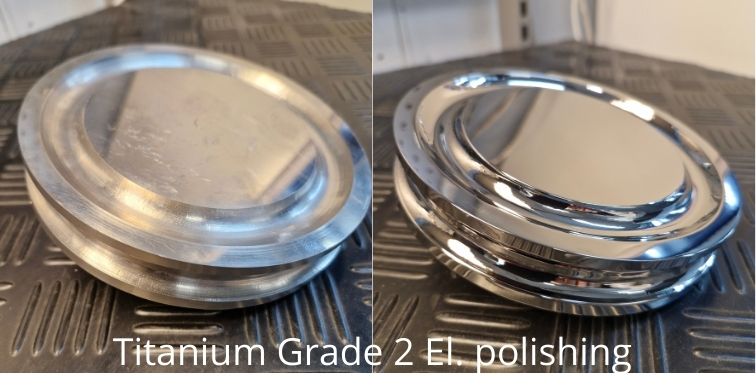
Polishing compounds contain waxes. If the finished surface may not contain polishing wax, a different process, such as electropolishing, may be required to achieve the required smoothness or reflectivity.
Frequently asked questions
What level of shine can be achieved on stainless steel
With suitable material, correct preparation and accessible component geometry, stainless steel can be finished to a complete mirror-quality surface. The target should be confirmed with a sample or clear visual specification.
Can all stainless steel components be polished
Many shapes and sizes can be polished, but access, geometry, sharp features, material quality and the required finish affect the method and feasibility. Complex components may need testing before the whole surface is processed.
How do you prevent overheating and an uneven surface
Heat is controlled through suitable polishing wheels, correct machine speed, moderate pressure, efficient movement and cooling where necessary. Evenness also depends on the quality of the earlier grinding stages and the operator’s experience.
What information is needed for a proposal
Send component photos or drawings, identify the material and weld type, describe the current surface and required finish, provide quantities, location and schedule, and indicate whether the work is a one-off project or part of longer cooperation.
Discuss your stainless steel polishing project
Tell us what needs to be polished, what the current surface looks like and how the final result should be evaluated. Include photos, drawings, reference samples or surface requirements where available. MG Advice will assess the preparation, polishing sequence, project format and most practical next step.